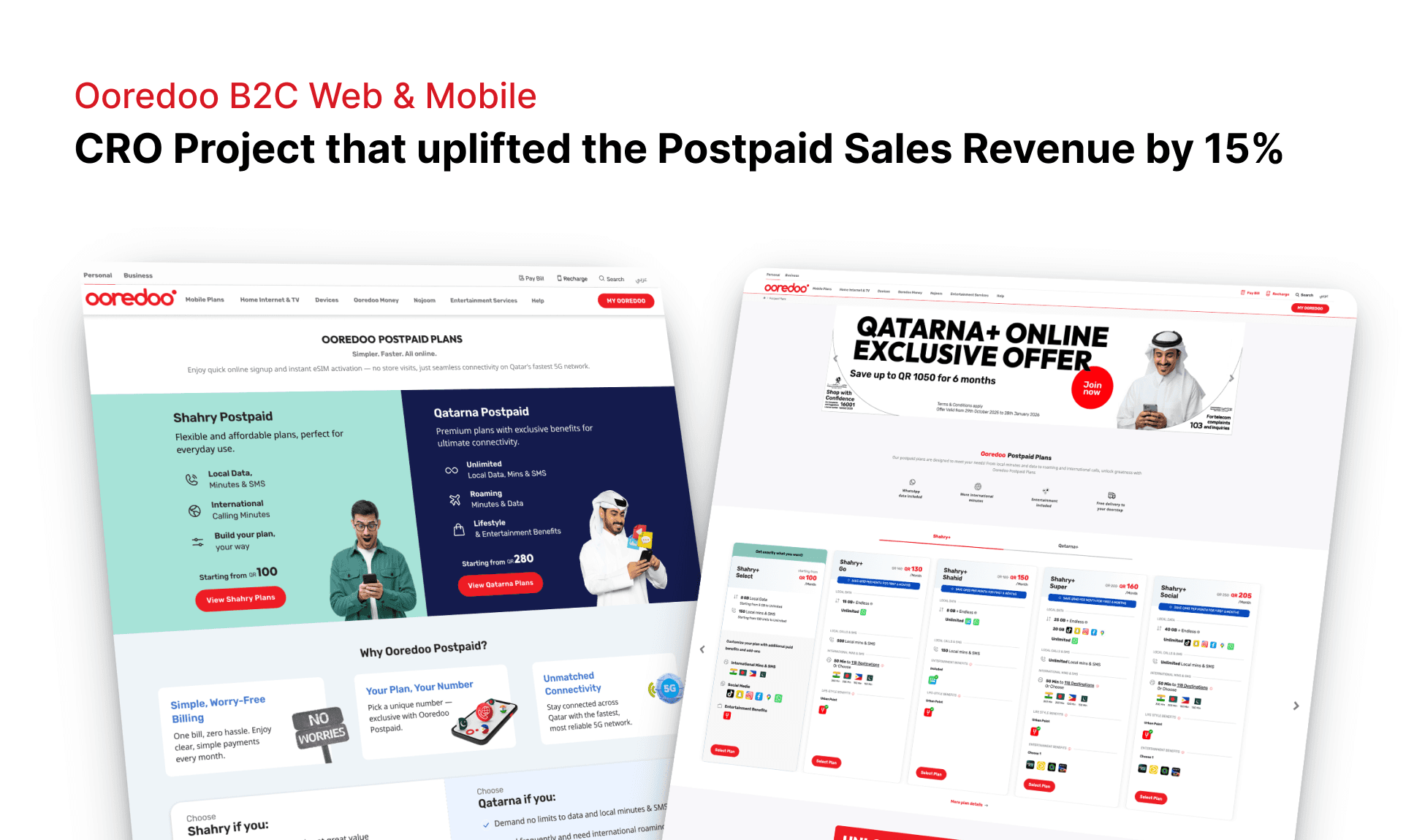
A CRO-led redesign of Postpaid Products that lifted Revenue by 15% in just 6 Months
What Does It Actually Take to Lift Postpaid Revenue by 15%?
Not a brand refresh. Not a new hero banner. Not a campaign.
It takes understanding exactly why users who arrived on our postpaid page with intent were leaving without picking a plan. It takes pulling Hotjar heatmaps, GA4 funnel data and Power BI sales figures simultaneously and asking what all three are telling you together. Building personas from real customer data.
A full purchase funnel audit. And a redesign precise enough to be proved by an A/B test. Running user testing that surfaces the insight nobody expected. Designing a precise intervention for every friction point you find. And proving every decision worked.
This is what CRO-led UX actually looks like end to end.
My Role
Senior UX Designer
Platform
Desktop & Mobile Web
Type
CRO-Led UX
Data Analysis
Hotjar · Google Analytics 4 · Power BI
+15% Revenue lift
3 Product Pages
4 Data Tools
My Role
I led the CRO-led redesign across desktop and mobile web alongside the product team.
I pulled and interpreted Hotjar heatmap and session data, GA4 for purchase funnel analysis.
I built two data-driven personas for Shahry and Qatarna customers using real sales figures data from Power BI.
I conducted competitive benchmarking of the purchase journey across e&, Virgin, Du and Circle.life.
I created user testing scenarios and also compiled the testing report with design changes recommendations for final designs.
I oversaw the Arabic RTL version ensuring conversion improvements carried across both language experiences.
Is it a good thing that the Hero Banner on your product page has 100% visibility and interaction?
My Hotjar Heatmaps told me a different story.
Hotjar showed rage clicks concentrated on the hero banner across both the portfolio and product pages. A promotional banner was commanding all above-the-fold attention even before users saw the product plans. So, is hero banner a valuable asset or a liability?
In addition, hero banner was not optimised for mobile layout, instead landscape version of desktop was scaled down and adapted to mobile view, which was surfacing accessibility issues as well.
My strategy for this redesign was addressing the bottom of ice berg i.e. Data Analysis and climbing to the tip of the berg i.e. Benchmarking.
How did I get to the bottom of the iceberg with my data deep dive?
I analysed heatmaps but I also paid attention to mid and deep funnels of purchase journey with Google Analytics 4.
GA4 funnel analysis revealed digital verification as the most severe drop-off point in the entire purchase journey. More than half of users who reached the verification step were not completing it. But users who completed verification successfully were purchasing at a very high rate. The problem was not intent. The funnel itself was also significantly longer than competitors.
I benchmarked that Ooredoo's new SIM journey ran to six steps. e& achieved the same in four. Virgin in three. Du in four. Every extra step was an exit opportunity the funnel did not need to create.
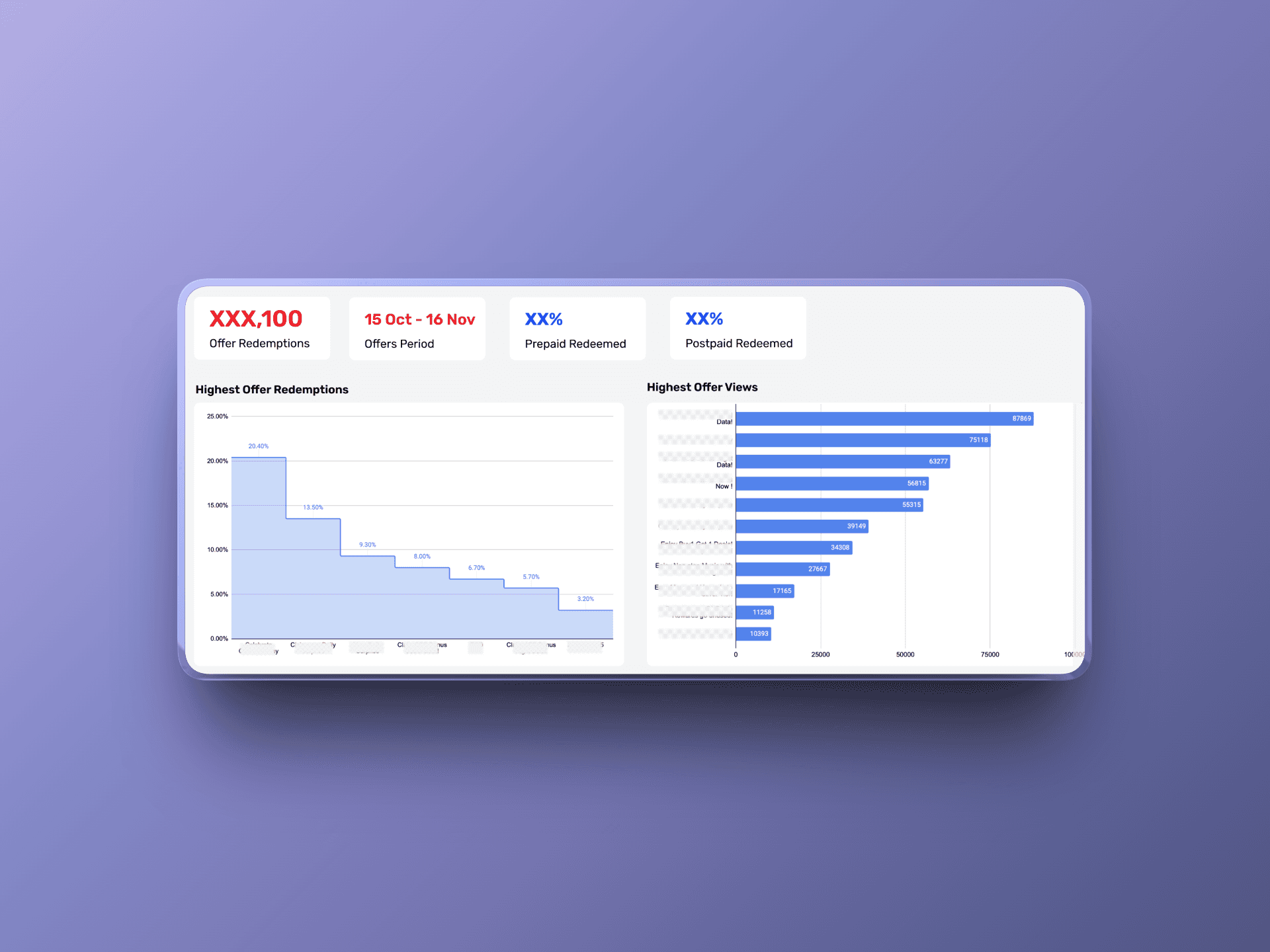
Power BI provided me an opportunity to collect data of demographics, purchase behaviour, gender split, nationality split, age range trends of both the Products. Incredibly, sales data showed a clear drop in volume as plans moved up in price, raising a direct design curiousty about how plan hierarchy was being communicated on the page.
Insight: When personas are built from real data they stop being a research deliverable and start being a design filter.
The Solution?
Place Product Plans above the fold for 100% visibility.
Most importantly, after designing, I user tested the design
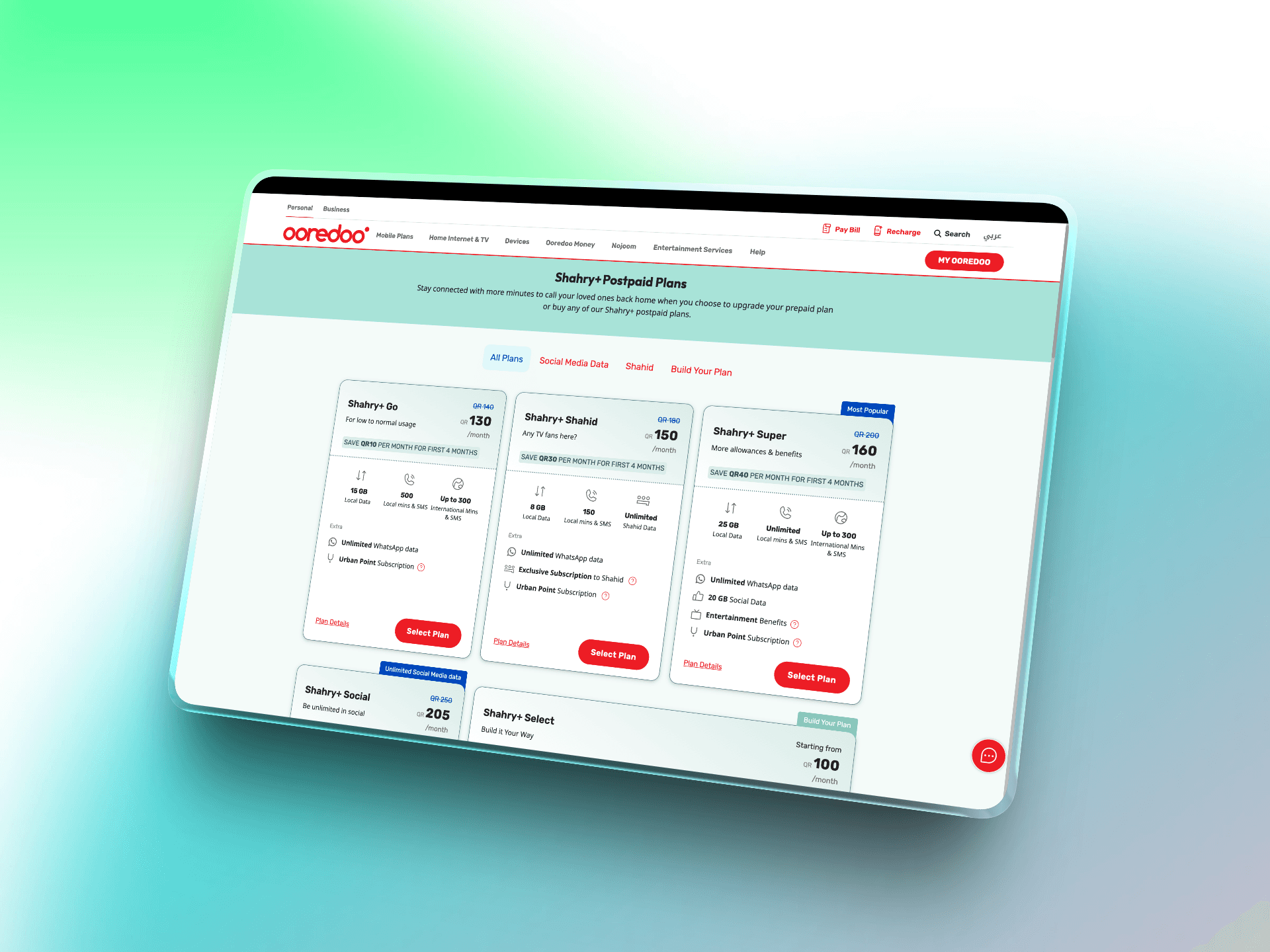
Filter like buttons introduced to land on plans faster
Users were scrolling through every plan to find the one relevant to them. Filter tabs deeplinked to plans
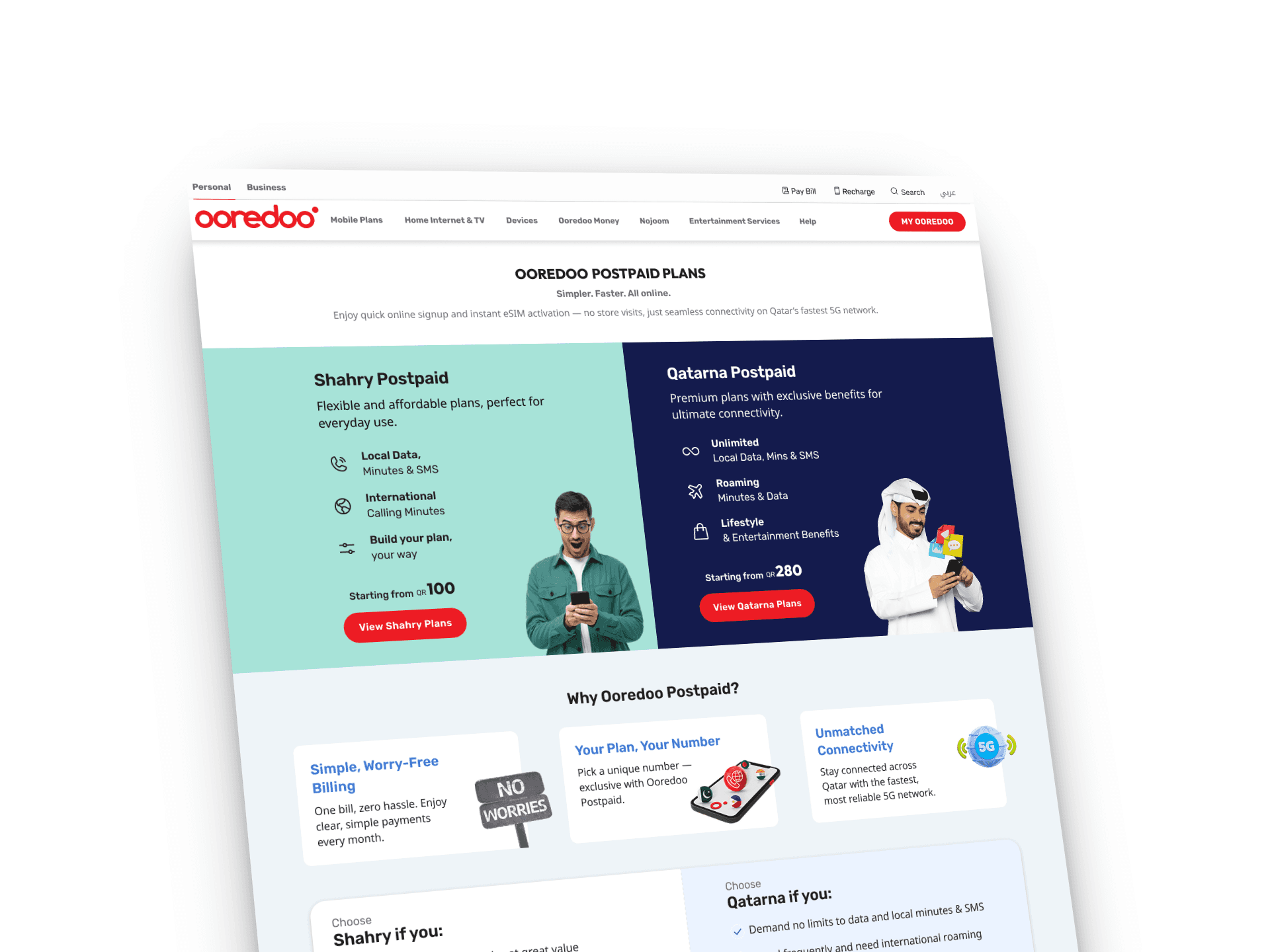
Clear branding done between both Products
Hotjar revealed that users wanted to know the differentiation more so distinct visual identities helped
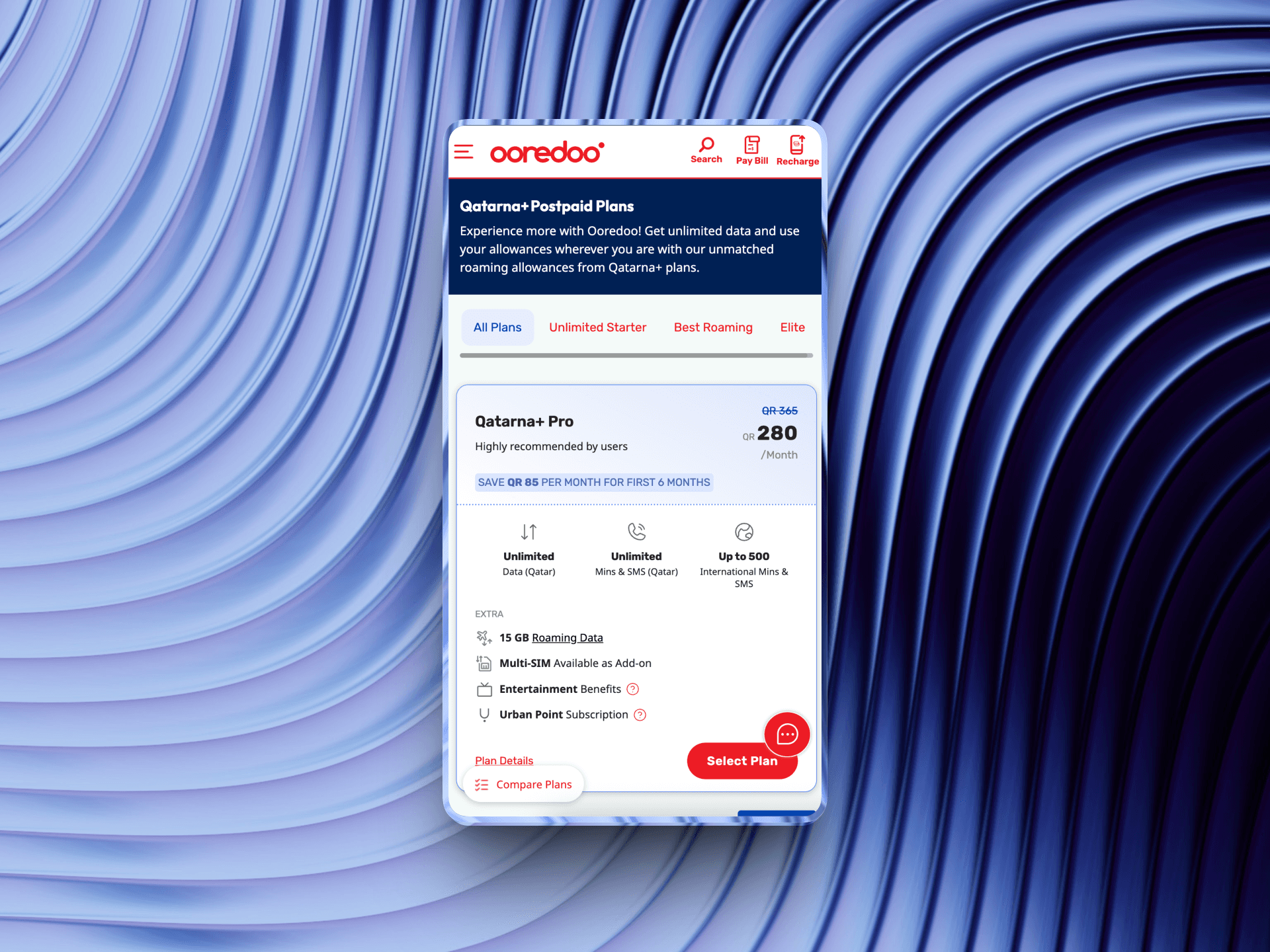
Higher-end plans of Unlimited Data given Premium feel
The redesign gave Qatarna the distinct premium identity to attract its crowd
What were the most impactful changes I made in the redesign?
Product Plans were moved above the fold.
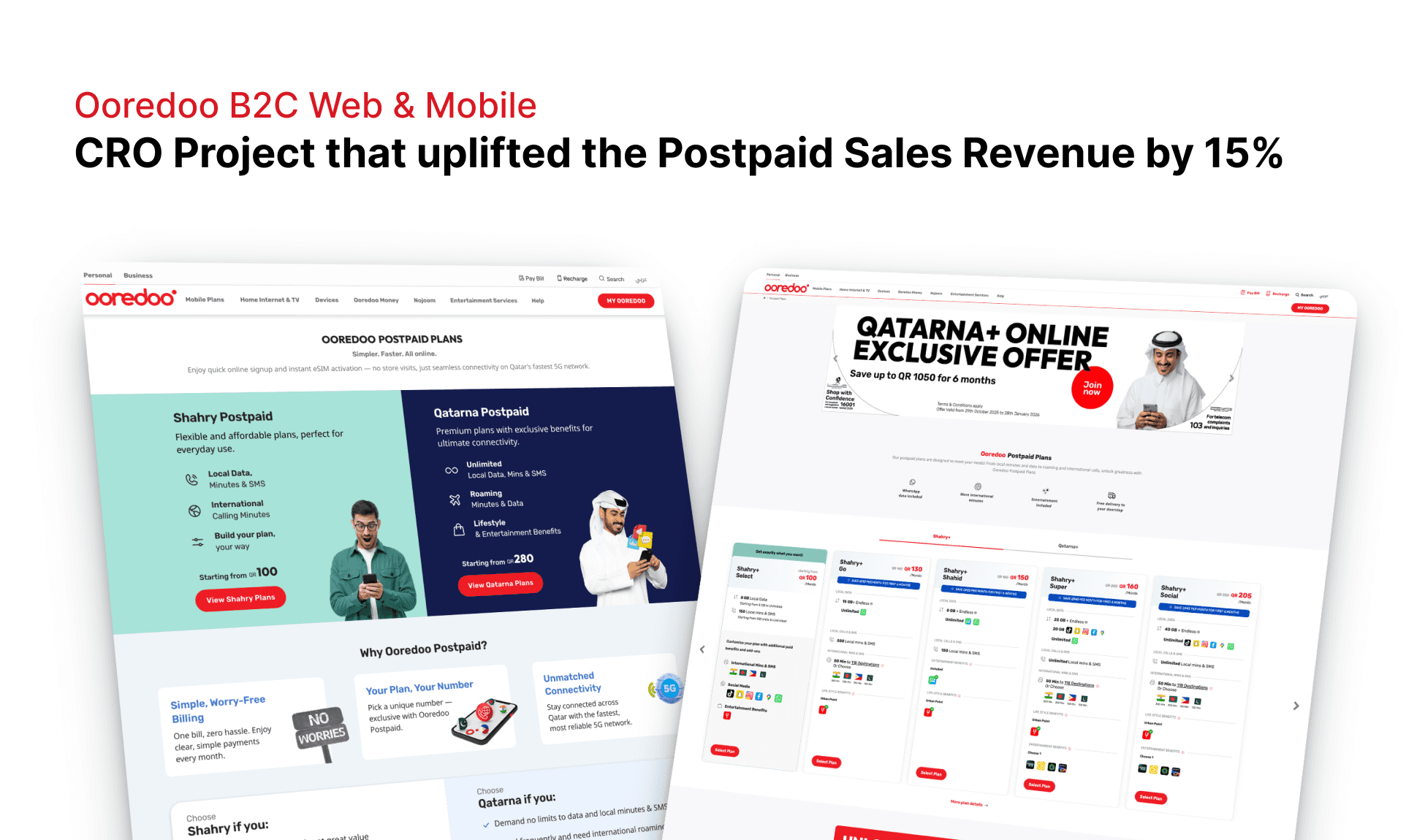
The hero banner was moved below the fold. Shahry and Qatarna became the first things users saw on arrival. Each product received a distinct visual identity built from the persona data. Shahry in teal green, positioned as flexible and affordable for everyday use with local data, calling minutes and a build-your-own-plan option. Qatarna in deep navy, positioned as premium with unlimited data, roaming and lifestyle benefits
How did I address the seven stages of sales funnel step 'evaluation' where users tend to make a choice between plans?
Comparison Table was introduced with a 'compare plans' sticky button. It was well loved feature in the user testing. What users pointed out was that they wanted price comparison too in the table, so we added it. (perks of testing, you can design for what user actually wants)
A Plan Details bottom sheet was also introduced on each plan card, opening a tabbed detail view covering plan specifications, international minutes and benefits. Users could evaluate fully without leaving the page or losing their position in the plan list.
T&Cs were moved inline into this bottom sheet, removing the FAQ redirect that was pulling users out of the evaluation stage of the funnel. Nielsen Norman Group's Recognition over Recall heuristic is clear: linking users away for T&Cs disrupts spatial orientation and increases abandonment. Keeping them in context removes that risk entirely.
The redesign did not ship on confidence. It shipped on evidence. A/B tests proved it
On the portfolio page, rage clicks dropped. Engagement moved from the hero banner to the product CTAs. Click through rate to both plans improved and drop-off during plan selection reduced.
On the product pages, scroll depth past the plan cards reached 95% in the variant. Filter tab engagement was high, validating what user testing had predicted. Plan Details clicks confirmed users wanted accessible depth before committing. Select Plan CTA engagement increased and churn rate dropped. The Arabic version showed consistent improvement across both language experiences as well.
What I learned
“Working on this project across all design stages, I learned that CRO is my passion because of how immersed I felt throughout.
Connecting dots between the data. Moving pieces. Influencing team members with data instead of opinions. Participating enthusiastically in rapid prototyping sessions and watching ideas come to life and become decisions in real time.
All of it confirmed something about myself. I really love diving deeper into user behaviour insights and making the needle move for both the business and the users.
If UX is my sun, CRO is probably my sunset.”
Bisma
View Full Case Study?
Want to see the full story? The complete deck includes all research, wireframes, iterations and final designs.
View the Next Case Study ->
© 2026 Design Portfolio All rights reserved. Designed by Bisma Munawar